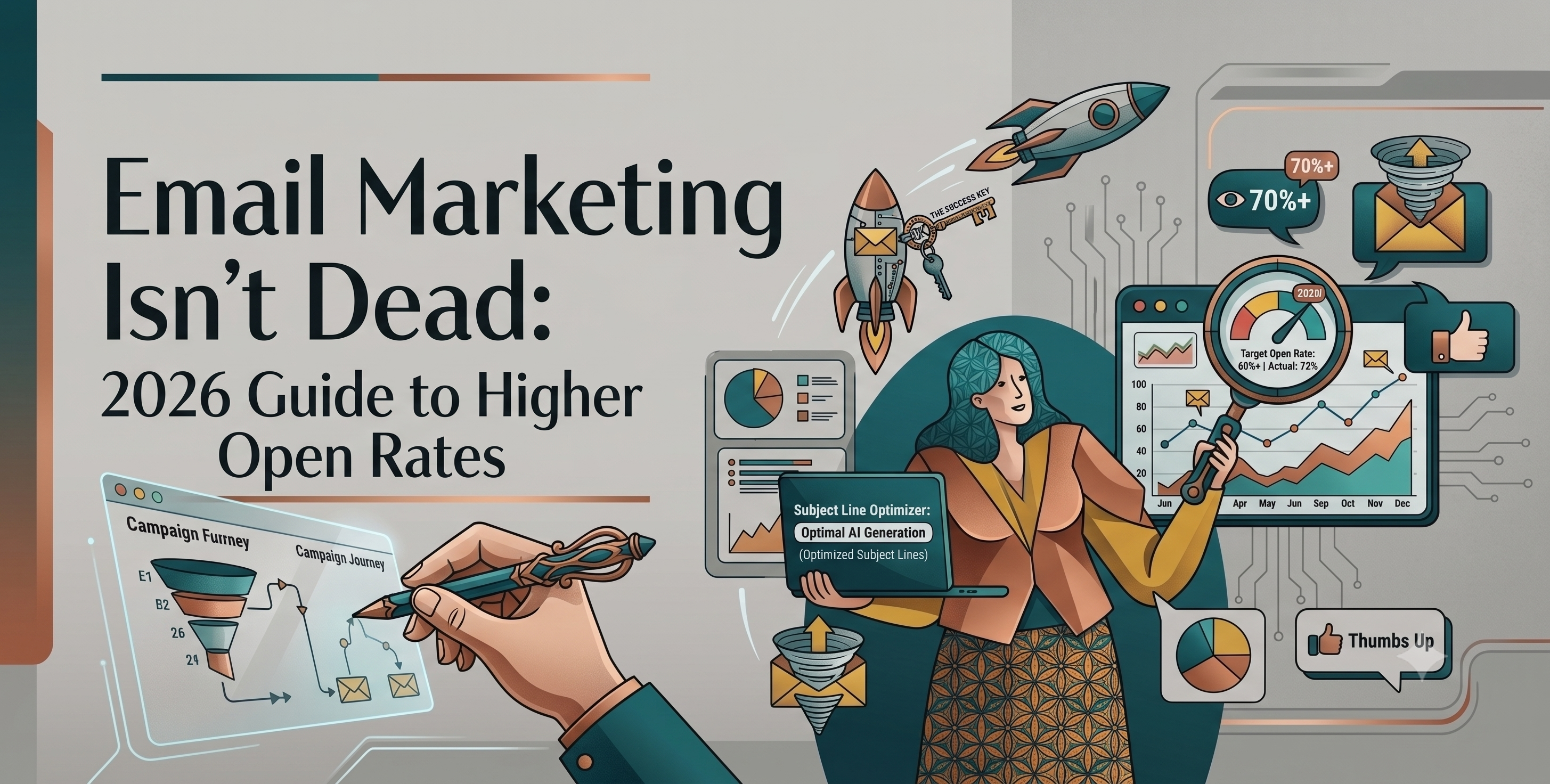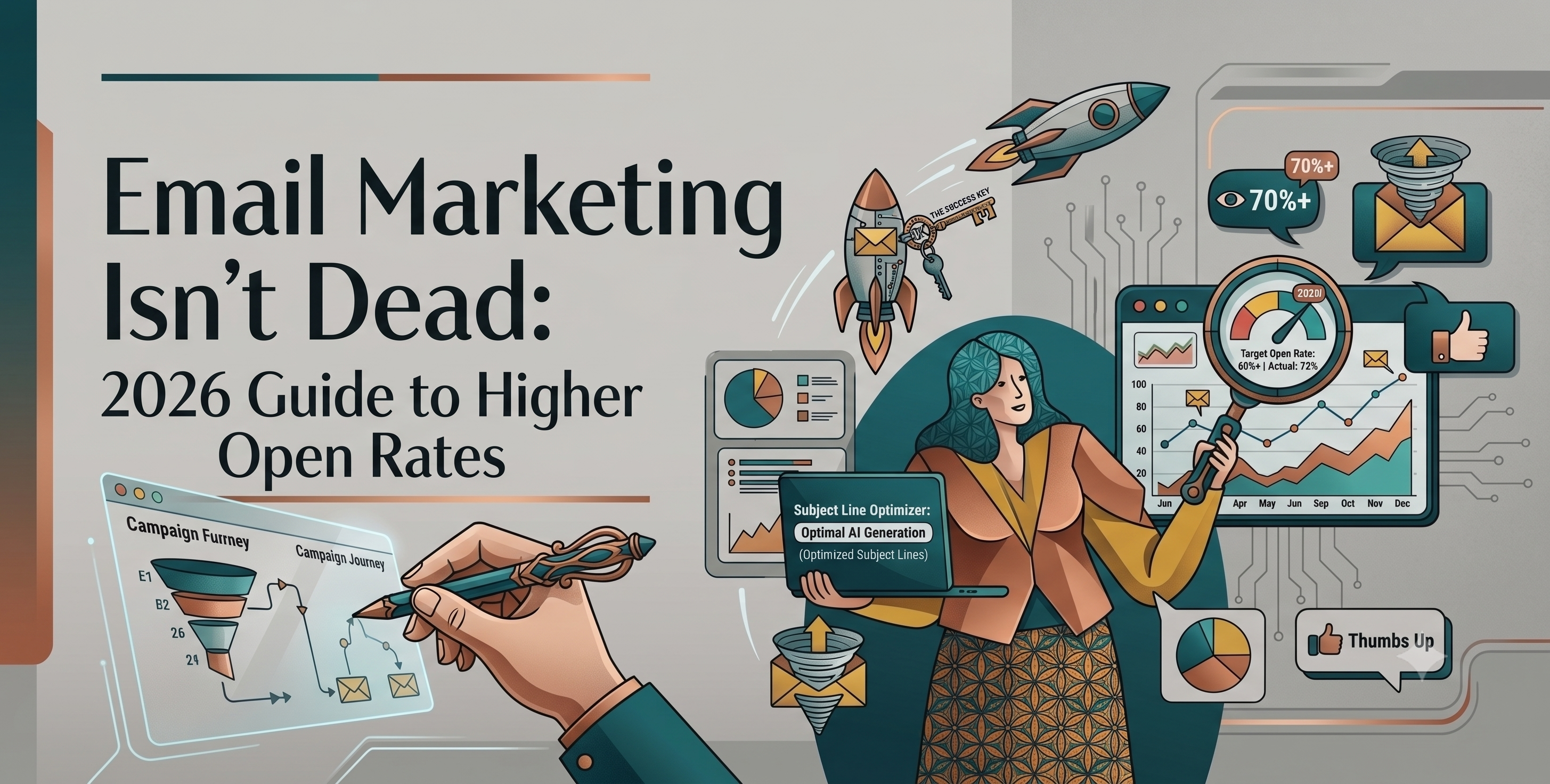
We heard a story about one of our clients. In a meeting, someone seriously told her that email marketing was basically finished and she should put all her money into social media ads instead. She almost bought it, but then she checked her own results. Turns out, email was quietly doing way better than all her other marketing efforts combined. She just hadn't noticed because everyone kept saying email didn't matter anymore.
This kind of thing happens all the time. People keep saying email marketing is dead, but the numbers just don't back it up. In 2026, for every dollar spent on email marketing, businesses are seeing an average return of $36 to $42. That's significantly more than paid search, social ads, and display ads put together. The real issue isn't that email itself is dying, but rather that the old ways of doing email campaigns are no longer effective. The channel is still strong for those who adapt to how it works today.
Why People Think Email is Dead (And Why They're Wrong)
The idea that email is dead usually comes down to one thing: declining open rates, or open rates that don't seem as meaningful as they used to. This part is actually true, but not for the reason most people think.
Since 2021, Apple's Mail Privacy Protection has been automatically pre-loading emails for many Apple Mail users. This counts as an open even if no one actually reads the message. Since Apple Mail is used by about half of all email users, a good portion of the opens you see are just phantom signals, not real engagement. So, when a business owner sees their open rate drop or stay the same, they assume email isn't working anymore. What's really happening is that the metric itself has become less reliable, not that the marketing channel has stopped performing.
This is actually good news once you understand it. It means that businesses still relying only on open rates are looking at a distorted picture. On the other hand, those who have adjusted their strategy have a real advantage.
What Good Looks Like in 2026
Before we talk about specific strategies, it's helpful to know what you should be aiming for. Across different industries, average open rates are typically between 30% and 43%, though this can vary a lot by sector. For example, financial services and healthcare often see higher rates, while e-commerce and marketing emails tend to be lower due to the sheer volume and competition in people's inboxes.
A more useful number to look at is the click-to-open rate, or CTOR. This tells you how many people who opened your email actually clicked on a link within it. This number has been steadily increasing and is around 6.8% on average across all industries. Unlike open rates, CTOR isn't affected by pre-loading. So, if your open rate looks flat but your CTOR is healthy or improving, it means your content is genuinely connecting with your audience. That's the metric you should be focused on, not just the open rate at the top of your report.
The Real Strategy for 2026: What's Actually Making a Difference
-
Focus on getting clicks, not just opens.
This is the most important change in thinking for 2026. An open rate shows if your subject line caught someone's eye, but it doesn't tell you much about whether your content was actually effective. Make click-through rate and click-to-open rate your main goals, and you'll start making decisions based on real user behavior rather than a metric that's partly skewed by privacy software.
-
Use AI for subject lines and send times, but keep your own voice in the content.
The data here is really impressive. Businesses using AI to create and improve their subject lines are seeing much higher open rates compared to emails with manually written subjects. Adding AI-powered send-time optimization can boost results even further. About two-thirds of marketers already using AI in their email campaigns are applying it to send times, because knowing the best time to send is highly individual for each subscriber, not just the day of the week.
Here's a key point: AI is great for optimizing delivery – figuring out when to send, which subject line works best, and who is most likely to engage right now. It's not as good at replacing your brand's unique voice in the actual email copy. Use AI as a tool for testing and timing, not as a substitute for your brand's personality.
-
Segmenting your audience is no longer optional.
Email campaigns sent to specific audience segments generate significantly more revenue than those sent to everyone. Some reports show segmented lists can bring in up to 760% more revenue than unsegmented ones. If you're currently sending the same email to your entire list without considering their past purchases, engagement level, or where they are in their relationship with your brand, this is the most impactful change you can make right now. Start simple: separate new subscribers from repeat customers, or active users from inactive ones. You don't need a complicated system to see the benefits.
-
Automated email sequences are quietly outperforming manual campaigns.
Automated emails, like welcome messages, abandoned cart reminders, and post-purchase follow-ups, bring in more revenue per send than one-off campaign blasts, even though they make up a small part of your total email volume. Welcome emails, in particular, stand out with higher open rates than general marketing emails because they arrive at a moment when people are most interested in your brand. If you don't have a welcome sequence set up, fixing that should be a top priority.
-
Always design for mobile first.
More than half of all emails are now opened on mobile devices. If your emails aren't designed with mobile in mind – meaning short subject lines, easy-to-read text, and buttons large enough to tap easily – you're losing potential customers before they even finish reading your first sentence. While desktop users might convert more in certain industries, mobile is where the initial impression is made, and that first impression determines whether someone will stick around to convert at all.
-
Respect people's inboxes, or you'll lose them.
The most common reason people unsubscribe is simple: too many emails. Sending two to four emails per week is a reasonable range for most businesses, but the ideal frequency really depends on how consistently valuable each email is. The best email programs treat every single email as something that needs to earn its place in someone's inbox, rather than just filling a spot on your content calendar.
A Quick Note on Timing
If you're looking for an easy way to get started, data consistently shows that Tuesday is the best day to send emails across most industries. Friday also performs well, while weekends, especially Sunday, generally see lower engagement. This isn't a hard rule to follow, but it's a good starting point while you gather your own data to figure out what works best for your specific audience.
What This Means for Your Business
Email marketing is no longer something you can just set and forget. But it's also not dead, declining, or being replaced by social media – the return on investment data makes that clear every year, even though the general narrative suggests otherwise. What has changed is the expertise needed to do it well: understanding which metrics truly reflect user engagement, using AI effectively without losing your brand's voice, and building segmented, automated sequences instead of relying on mass sends.
The businesses that are seeing real success with email in 2026 aren't the ones sending more emails. They're the ones sending smarter – to the right people, at the right time, with content that's actually worth opening.
If your email campaigns seem to have stalled, or you're unsure if your open rates are accurate, that's exactly the kind of review we conduct for clients every week at DevTeam Digital Marketing Agency. We'll help you understand what's really going on with your numbers and create a strategy based on metrics that show real engagement, not just inflated opens. Get in touch, and let's take a close look at how your email marketing is performing.